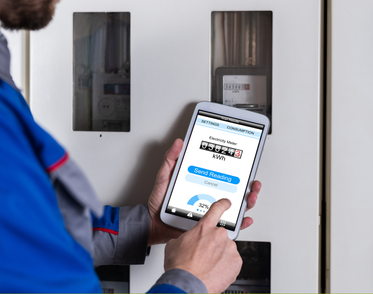

The UK’s smart metering programme has now reached over 39 million installations, marking significant progress towards national coverage. However, recent installation trends show that momentum has not yet increased to the level needed to deliver completion at pace, with activity in late 2025 falling slightly compared with both the previous quarter and the same period last year.

Despite this, the post-2025 policy framework provides a clearer and more structured path towards completion by 2030. The focus is no longer solely on installation volumes, but also on ensuring the wider system works effectively, this includes stronger expectations on suppliers to resolve faults quickly, replace ageing equipment, and maintain devices in full smart functionality.
Government continues to emphasise the wider value of smart metering. Beyond enabling more accurate billing, smart meters support lower energy consumption, improved visibility of demand across the grid, and greater consumer control over energy use. They also underpin the flexibility required to support the UK’s Clean Power 2030 ambitions.
A key development in strengthening the system is the transition to 4G WAN communications infrastructure. This upgrade will improve network resilience, connectivity and coverage, helping to ensure smart meters remain reliable as older 2G and 3G networks are phased out. In turn, this supports greater use of smart tariffs and enables households to participate more actively in flexible energy services.
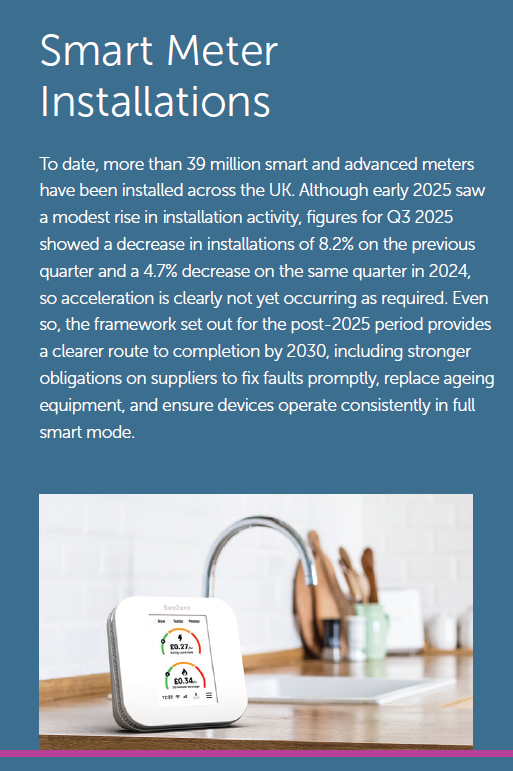
Looking ahead, the post-2025 framework gives greater certainty to the sector, with clearer expectations and milestones through to 2030. This allows industry to plan more effectively, from building installer capacity and managing supply chains to preparing for closer integration between smart meters and low-carbon technologies such as EV charge points, heat pumps and energy storage systems.
BEAMA continues to engage with government on these developments. Through recent consultations, including the Enhancing the Smart Meter Installation Journey work, we have highlighted the need for practical improvements. These include better coordination between smart meter installations and low-carbon technology deployment, addressing installer capacity constraints, improving local engagement in slower rollout areas, and ensuring a consistent customer experience, particularly when resolving faults or replacing legacy equipment.
As the rollout progresses, success will depend not only on completing installations, but on ensuring the system is reliable, integrated and able to support the UK’s evolving energy landscape.



Join the Metering Solutions Group
Powering Smart Energy Through Metering. Join BEAMA’s Metering Solutions Group to shape the technologies behind a smart, flexible energy system. Influence policy, stay ahead of change, and connect across the metering landscape.